
How to Follow Up on a Flooring Quote That Went Quiet
Flooring quotes stall for five reasons. Here's each one, a four-touch follow-up cadence with scripts, and what to change before you send so more get approved.

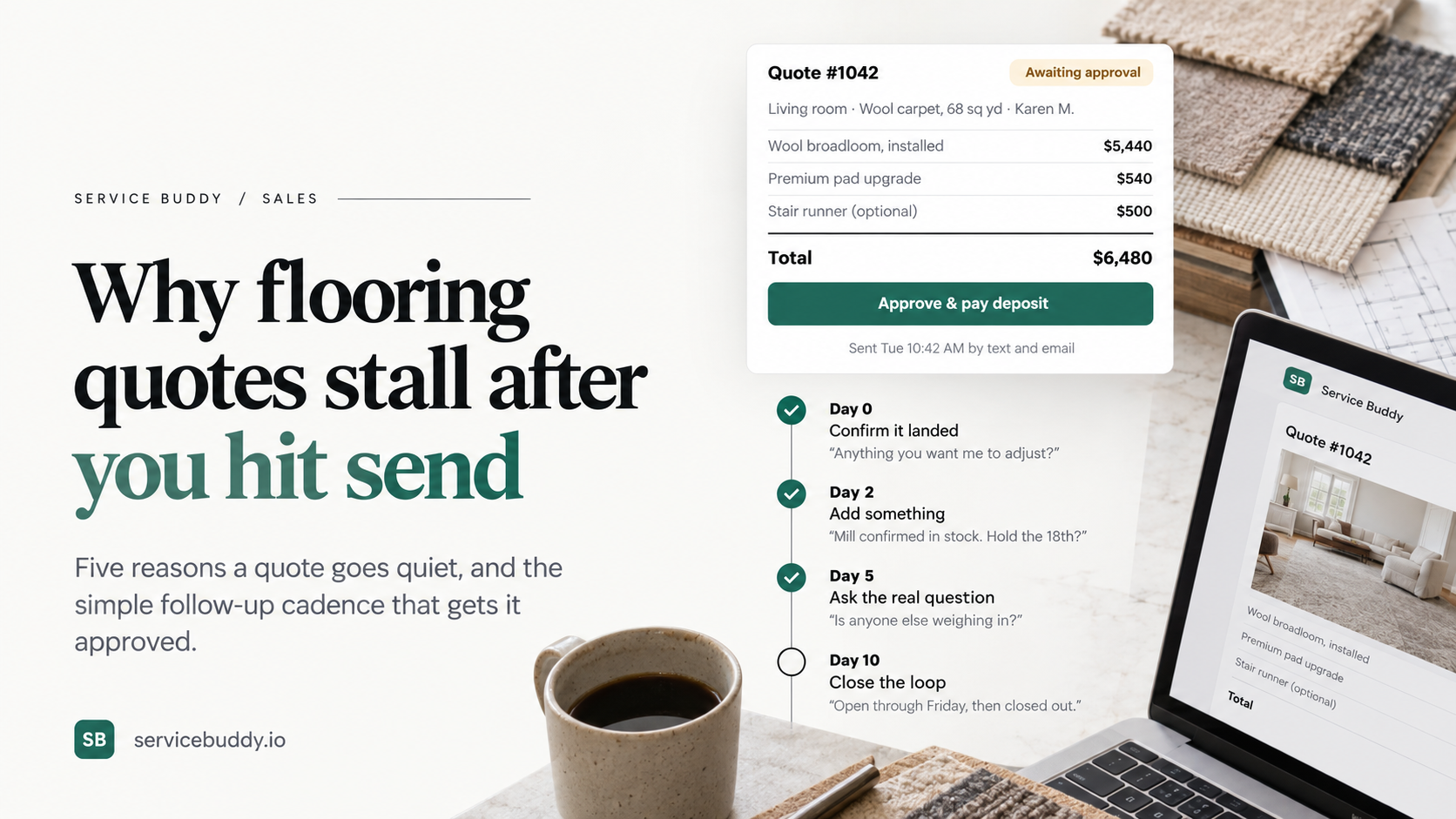
A flooring quote stalls after it's sent for one of five reasons: it arrived as a PDF the customer can't act on, it has no deadline, nobody followed up within 48 hours, the customer is waiting on someone else (a spouse, a designer, a contractor), or the price landed without options. A simple four-touch follow-up cadence, same day, day two, day five, and day ten, each with a specific ask, recovers a large share of quotes that would otherwise go quiet. The rest of this post explains each stall, the cadence, and what to change before you send so fewer quotes stall in the first place.
I've written before about how long it should take to send a flooring quote. Short version: fast. That post is about the clock between the measure and the send button. This one is about the clock that starts after. Because once a store gets quote speed under control, a different problem shows up: the quote goes out in 30 minutes and then sits in someone's inbox for three weeks.
Quote speed is a solved problem. Approval speed isn't.
Here's what I see when I look at a showroom's open quotes during onboarding. There is a pile of them. Some are a few days old. Many are a few weeks old. A few are from last season. Nobody can say, for any given one, whether the customer is still deciding, bought from someone else, or forgot.
That pile is not a sales problem. The salesperson did their job: they measured, priced, and sent. It's a process problem, because the store has no defined answer to the question "what happens on day three if they haven't replied?" So what happens is nothing, or a one-line "just checking in" email, which is roughly the same as nothing.
The fix starts with understanding why quotes stall, because each reason has a different remedy.
The five reasons a flooring quote stalls
1. The quote arrived as something the customer can't act on
A PDF attached to an email is a document, not a decision. The customer opens it on their phone, squints at the line items, and thinks "I'll look at this properly tonight." Tonight becomes the weekend. To approve it they have to reply, or call, or come back in, and then arrange a deposit separately. Every one of those is a step where the sale can pause.
Compare that to a quote the customer can approve, sign, and pay a deposit on from the same screen they're reading it on. The decision and the action are the same motion. Stores that make this change usually notice the shift before they measure it: approvals start arriving at odd hours, from phones, within minutes of the send.
2. There is no deadline, so there is no decision
Most flooring quotes are open-ended. "Let us know when you're ready." That sounds accommodating. What it communicates is that nothing changes if they wait.
In flooring, things do change if they wait, and you should say so. In-stock rolls sell. Mill lead times move. Install calendars fill up before the holidays. Pricing on special-order goods is only good as long as the mill's pricing is. A quote with a stated validity window and a stated install date if approved by a certain day gives the customer a real reason to decide this week instead of eventually.
3. Nobody followed up inside 48 hours
The research on lead response is blunt. A study published in Harvard Business Review on the short life of online sales leads found that companies that contacted a prospect within an hour of an inquiry were nearly seven times as likely to qualify the lead as those that waited even an hour longer, and more than 60 times as likely as those that waited a day or more. That study looked at online inquiries, not flooring quotes specifically, but the direction is the same one every showroom owner already knows from experience: interest decays fast.
A quote is a warm lead at its warmest. The customer just spent time in your store, had a measure, and is actively picturing the carpet in the room. Two days of silence after the send is enough for that picture to fade, or for the store across town to send theirs.
4. The customer is waiting on someone else
This is the most common stall and the least visible. The decision isn't theirs alone. A spouse needs to see the sample. The designer is reviewing it against the rest of the room. A contractor hasn't confirmed when the subfloor will be ready. The customer isn't ignoring you. They're waiting too.
You can't remove the other person, but you can find out they exist. A follow-up that asks "who else is weighing in on this?" turns an invisible stall into a known one, and often gives you a way to help: send the second sample, join the designer call, provide a rough install window so the contractor can plan around it.
5. The price landed without options
A single number invites a single question: is this too much? Two or three options invite a different question: which one? A quote that shows the wool they loved, the nylon that's 30% less, and the pad upgrade as a line they can toggle gives the customer something to do other than hesitate. It also protects the salesperson from the discount conversation, because the customer can self-select down instead of asking you to come down.
The follow-up cadence that closes stalled quotes
This is the schedule I'd put in place in any showroom that doesn't already have one. Four touches over ten days, each with a different purpose and a different ask. Text where you have permission to text; it gets read. Email when there's something to attach.
Day 0: confirm it landed
Within an hour of sending, a short text. Not a pitch. A confirmation and an open door.
"Hi Karen, the quote for the living room carpet just went out to your email. You can approve and put down the deposit right from your phone. Anything you want me to adjust before you look it over?"
The purpose is to make sure the quote didn't go to spam, and to give the customer an easy way to raise an objection while you're both still thinking about it.
Day 2: add something
Two days later, a touch that carries value, not just a nudge. The sample photo in daylight. The install window you can hold. The answer to a question they asked on the floor.
"Karen, I checked with the mill. The wool is in stock, so if you approve this week I can hold the 18th for install. Want me to pencil that in?"
This is the moment to introduce the deadline if the quote didn't carry one. Not as pressure. As information: here's what's available now, and here's when that changes.
Day 5: ask the real question
By day five, silence usually means a stall, not a no. The job of this touch is to find out which stall.
"Hi Karen, wanted to make sure you have what you need to make a decision on the carpet. Is anyone else weighing in, or is there a question I haven't answered?"
You'll be surprised how often the reply is "my husband wants to see it in the room" or "our designer is on vacation until Monday." Now you know what to do.
Day 10: close the loop
The last scheduled touch. It should be direct and give the customer permission to say no, because a clear no is more valuable than another week of maybe.
"Karen, I'll keep this quote open through Friday. If the timing isn't right, no problem, just let me know and I'll close it out. If you'd like to move forward, the approval link is still live."
Some of these come back as yes. Some come back as "not right now, but call me in the spring." Both are better than an open quote nobody can account for.
After day ten, the quote moves to a nurture list, not the active pile. That's what separates a store with a working pipeline from a store with a pile.
What to change before you send
The cadence rescues quotes. These changes stop them from stalling.
Make the quote approvable from a phone. Sign, approve, deposit, all on the same screen. If your current process ends with a PDF, this is the single biggest lever you have.
Put a validity date on every quote. Tie it to something true: the mill's price hold, the install calendar, the in-stock status of the roll. Thirty days is common, but shorter is often better for in-stock goods.
Show options. Two or three, not seven. The product they loved, a value alternative, and the upgrades (pad, fiber protection, stair runner) as line items they can add or drop.
Set the deposit expectation on the floor. If the customer already knows the deposit is 50% and can be paid by card or ACH when they approve, there is no second conversation to schedule.
Ask who else is involved before they leave. "Will anyone else be part of this decision?" Thirty seconds in the showroom saves five days of guessing later.
What to track
You can't improve approval speed if you don't measure it. Three numbers:
Quote-to-approval time. Median days from send to signed. This is the number the cadence should move.
Open quotes older than seven days. A list, reviewed weekly. Every quote on it should have a next action and a date, or be closed.
Win rate by number of follow-ups. If you track touches, you'll quickly see where the returns are. Don't be surprised if the day-five touch turns out to be the one that converts. It's the one that surfaces the real stall.
If you want the broader set, I covered the five metrics every flooring store owner should know in a separate post. Quote-to-close rate is one of them.
Where software fits (and where it doesn't)
Software doesn't make the follow-up call. A person does. What software can do is remove the reasons the call didn't happen.
In Service Buddy, quotes go out by text or email and the customer can approve, sign, and pay from any device with a card, ACH, or Apple Pay. The signed quote and the receipt are sent automatically, so the approval and the deposit happen in one motion instead of two conversations. That takes stall number one off the table.
Every text and email with the customer is tracked on the customer record, so whoever picks up the day-five touch can see what was already said. And when a quote does convert, it becomes a job with one click and lands on the install calendar, which is what lets you promise a date on day two and actually keep it.
The cadence still has to be run. But it's a lot easier to run when the quote is a link instead of an attachment, and the list of open quotes is a screen instead of a memory.
Frequently asked questions
How many times should you follow up on a flooring quote?
Four scheduled touches over ten days is a practical standard: a same-day confirmation, a day-two touch that adds information (a sample photo, an install window), a day-five question about what's holding the decision, and a day-ten close-the-loop message with a clear deadline. After that, move the quote to a longer-term nurture list rather than continuing to chase it.
Why do customers go quiet after receiving a flooring quote?
The most common reasons are that the quote arrived as a PDF they can't act on, there was no deadline, nobody followed up within two days, they're waiting on a spouse, designer, or contractor, or the price was presented as a single number with no options. Most of these are fixable before the quote is sent.
Should a flooring quote have an expiration date?
Yes. Tie it to something real: the mill's pricing hold, whether the roll is in stock, or the install calendar. A stated validity window gives the customer a reason to decide this week instead of eventually, and it protects you from honoring stale pricing on special-order goods.
Is it better to follow up on a quote by text or email?
Text, if the customer has agreed to it, because it gets read quickly and invites a short reply. Use email when you need to attach something, like a revised quote or sample photos. The best approach is often both: a text to say the email is there.
What should a quote follow-up message say?
Each touch should have one purpose. Confirm it arrived and offer to adjust. Add new information and introduce the deadline. Ask directly what's holding the decision and who else is involved. Then close the loop with a final date and permission to say no. Avoid generic "just checking in" messages, which give the customer nothing to respond to.
See the approval side of quoting
If your open-quote pile is bigger than you'd like, the fastest fix is making the quote itself easier to say yes to. Book a live demo and we'll walk through what a quote looks like when the customer can approve and pay it from their phone, and what your open-quote list looks like when it's a screen instead of a folder.
Related Blog Posts


See Service Buddy in action with a live demo
Everything you need to run your flooring business, Service Buddy is your all-in-one management platform.