
5 Flooring Store Metrics Every Owner Should Know (2026)
Gross margin per job, quote-to-close rate, overdue samples — 5 flooring store metrics every owner should know, and how AI pulls them up in seconds.

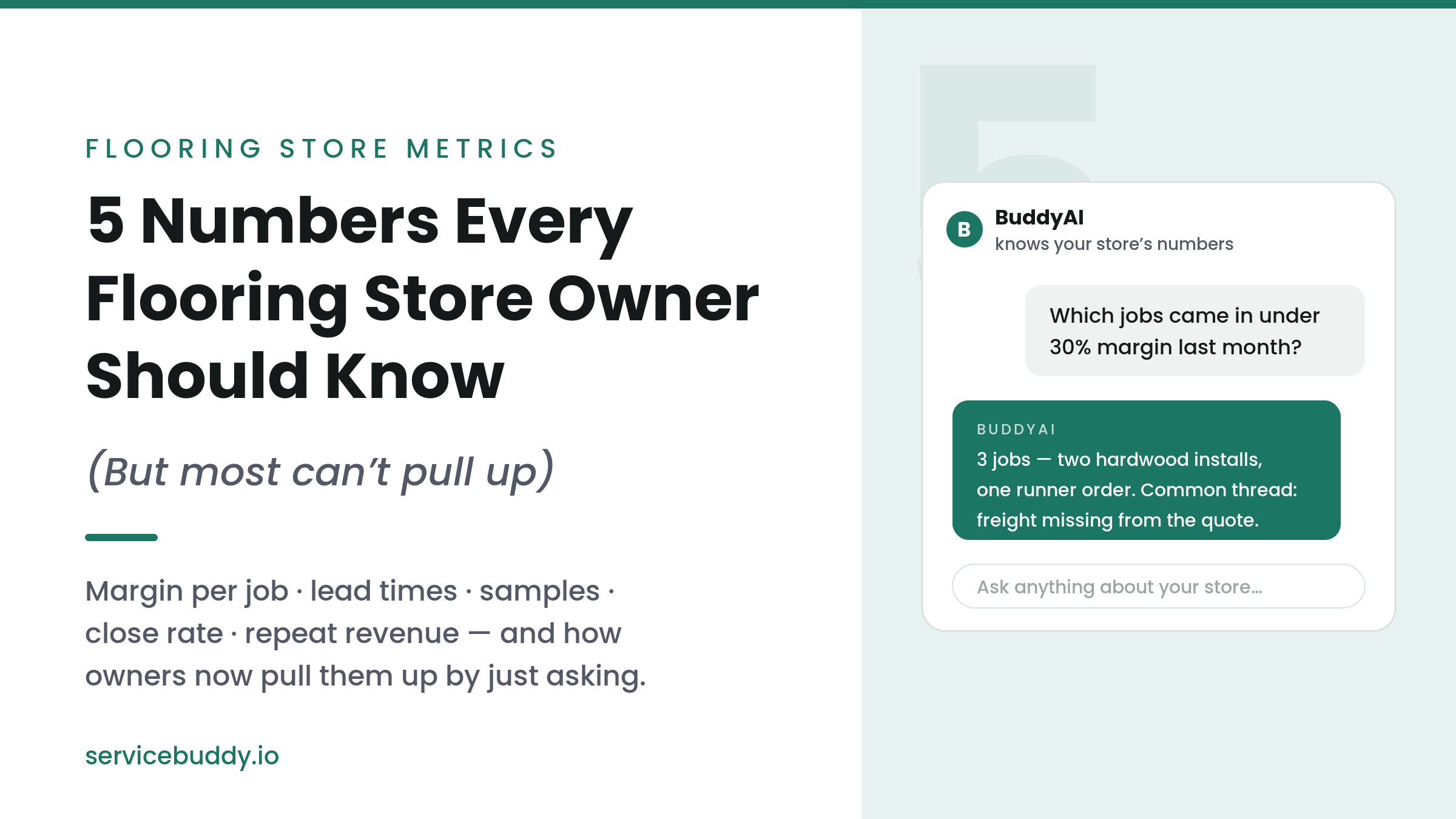
5 Numbers Every Flooring Store Owner Should Know (But Most Can't Pull Up)
Five numbers tell you more about the health of a flooring store than any monthly P&L: gross margin per job, special-order lead time vs. the date you promised, samples checked out and overdue, quote-to-close rate, and the share of revenue from repeat and referral customers. Most owners can't pull up a single one of them without an hour in spreadsheets — and that gap is where profit quietly leaks. The stores that run best aren't the ones working hardest. They're the ones that can answer these five questions in seconds.
Here's the test: if someone asked you each of these right now, could you answer from data — not from gut? If not, this post is for you. We'll walk through why each number matters, why your current setup probably can't produce it, and what it looks like when you can simply ask an AI that already knows your business.
1. What's your gross margin per job — not per year?
Your accountant can tell you the store's margin for the year. That number hides everything that matters. A healthy annual margin can be propping up a category, a salesperson, or a type of job that loses money on every single order.
Per-job margin is where the truth lives. The install that ate two extra labor days. The special order where freight wiped out the markup. The "good customer" who negotiates every quote down 10%. Roll those up by product line, by salesperson, by job type, and you know exactly where to raise prices, where to renegotiate, and what work to stop taking.
Most stores can't see this because costs live in three places — the quote in one system, the PO in another, installer labor on paper. Nobody assembles it per job, so nobody sees it. When quotes, purchase orders, and job costs live in one system, margin per job isn't a project. It's a column.
The question you should be able to ask: "Which jobs last month came in under 30% margin, and what did they have in common?"
2. How does your special-order lead time compare to what you promised?
Every special order carries two dates: the one the vendor quoted you and the one you told the customer. The gap between them is where your reputation lives.
Most owners know their feeling about lead times — "the mill's been slow lately." Few can say: average days from PO to receipt, by vendor, this quarter, versus what we promised customers. That's the number that tells you which vendor is quietly costing you callbacks, which promise dates your salespeople should stop making, and which orders need a proactive call today — before the customer calls you.
Chasing this manually means cross-referencing PO dates against delivery paperwork against whatever was said on the sales floor. Nobody does that weekly. So the first sign of a late order is an angry phone call.
The question you should be able to ask: "Which open special orders are going to miss their promised date this week?"
3. How many samples are checked out right now — and how many are overdue?
Samples walk out the door every day, and every board in a customer's trunk is inventory you paid for and a deal frozen mid-decision. A customer holding a sample is your hottest lead in the building — and at most stores, nobody knows who's holding what, or for how long.
This number matters twice. As inventory: boards and books cost real money to replace, and most stores write off a shameful pile every year. As sales: a sample out more than a week without a follow-up isn't a pending decision, it's a dying one. The follow-up call — "how did the Berber look in the living room?" — closes deals, but only if you know who to call.
If samples are tracked on a clipboard (or not at all), the honest answer to "how many are out?" is a shrug. With QR-labeled inventory tracking, checkout takes one scan, and the overdue list builds itself.
The question you should be able to ask: "Who has samples out more than 7 days, and what were they quoted?"
4. What's your quote-to-close rate — and how fast do you quote?
You know roughly how many quotes go out. Do you know what percentage close? By salesperson? By product category? By how long the quote took to send?
That last cut is the one that stings. In flooring, the fastest proposal usually wins — a quote sent the same afternoon closes at a different rate than one sent three days later. If you can't segment close rate by speed, you can't see what slow quoting actually costs you, so it never becomes anyone's priority to fix.
Close rate by salesperson tells you who needs coaching. Close rate by category tells you where your pricing sits versus the market. Close rate by speed tells you whether your process is losing deals your showroom already earned. Three levers, all invisible if quotes live in Word docs and sent-mail folders instead of a system that tracks every proposal from sent to signed to paid.
The question you should be able to ask: "What's our close rate on quotes sent same-day versus quotes that took 2+ days?"
5. What share of your revenue comes from repeat and referral customers?
New-customer marketing is expensive. Your past customers already trust you, already have your work in their home, and — in flooring — will buy again: the bedroom after the living room, the runner after the stairs, the cleaning after the rug purchase. Referral and repeat revenue is the cheapest revenue you'll ever earn.
But you can't grow a number you can't see. What percentage of last quarter's revenue came from people who'd bought before? How many customers from two years ago have never heard from you since? Which past customers bought hardwood but never heard about your cleaning service? If your customer history is scattered across an old POS, a spreadsheet, and someone's memory, those questions are unanswerable — so the follow-up never happens, and the easiest sales walk to a competitor's showroom.
A CRM built for flooring keeps every quote, job, and purchase on one customer record, which makes repeat-revenue share a report — not a research project.
The question you should be able to ask: "Which customers spent over $5,000 with us 18+ months ago and haven't been contacted since?"
The real problem isn't discipline. It's retrieval.
Notice what all five numbers have in common: the data already exists in your store. Every one of these is sitting in your quotes, POs, invoices, and job records right now. The problem is it's spread across a legacy POS, QuickBooks, spreadsheets, and paper — so "pulling a number" means an evening of assembly work. And numbers that take an evening to pull don't get pulled.
That's a systems problem, not an effort problem. Owners don't lack the discipline to track five metrics. They lack a setup where tracking is free.
What it looks like when you can just ask
This is the part that's changed. When your quotes, jobs, inventory, orders, and payments run through one platform, the five numbers above stop being reports someone has to build — they become questions you ask out loud.
That's what BuddyAI does inside Service Buddy. It's an AI agent that already knows your business — every quote, every job, every PO, every payment — because it sits on top of the system where all of that lives. You ask in plain English, the way you'd ask your best office manager:
No exports, no formulas, no waiting for month-end. Every action your team takes in Service Buddy feeds the answers in real time — and reporting syncs two-way with QuickBooks Online, so the books stay right without re-keying.
Start with one number this week
You don't need a dashboard with forty widgets. Pick the number that scares you most — for most stores it's margin per job — and get to where you can answer it in under a minute. Then add the next one. Five questions, answered weekly, will change more decisions than any annual review.
And if pulling even one of them means an evening in spreadsheets, that's not a you problem — it's your software telling you it wasn't built for this. Book a live demo and ask BuddyAI these five questions yourself, live, on real data. The answers take seconds. That's the whole point.
FAQ
What are the most important metrics for a flooring store? Five stand out: gross margin per job, special-order lead time vs. promised dates, samples checked out and overdue, quote-to-close rate, and the share of revenue from repeat and referral customers. Together they cover profitability, operations, sales effectiveness, and customer retention.
Why is gross margin per job better than annual margin? Annual margin averages away the problems. Per-job margin shows exactly which products, salespeople, or job types are losing money — so you can fix pricing or process on the specific work that's leaking profit, instead of guessing.
How do I track my quote-to-close rate? Every quote needs to live in one system that records when it was sent, whether it was approved, and when. Then close rate by salesperson, category, or quoting speed becomes a filter rather than a manual count. Quotes sent as PDFs from email can't be tracked this way.
Can AI really pull these numbers for a flooring store? Yes — if the AI is connected to the system where your quotes, jobs, orders, and payments actually live. BuddyAI, built into Service Buddy, answers plain-English questions like "which jobs came in under 30% margin last month?" from your live data, with no exports or spreadsheets.
What's the first metric a flooring store owner should start tracking? Gross margin per job. It's the number with the most direct line to profit, and it usually surprises owners the most. Once you can pull it in under a minute, add quote-to-close rate next.
Related Blog Posts


.svg)
See Service Buddy in action with a live demo
Everything you need to run your flooring business, Service Buddy is your all-in-one management platform.