
Why Flooring Retailer Website Visits Dropped 21% but Form Fills Only Dropped 5% (And What It Means for How You Sell)
Flooring website traffic fell 21% in Q1 2026 but form submissions only dropped 5%. Here's what the gap means and why sub-30-minute response now decides who wins.

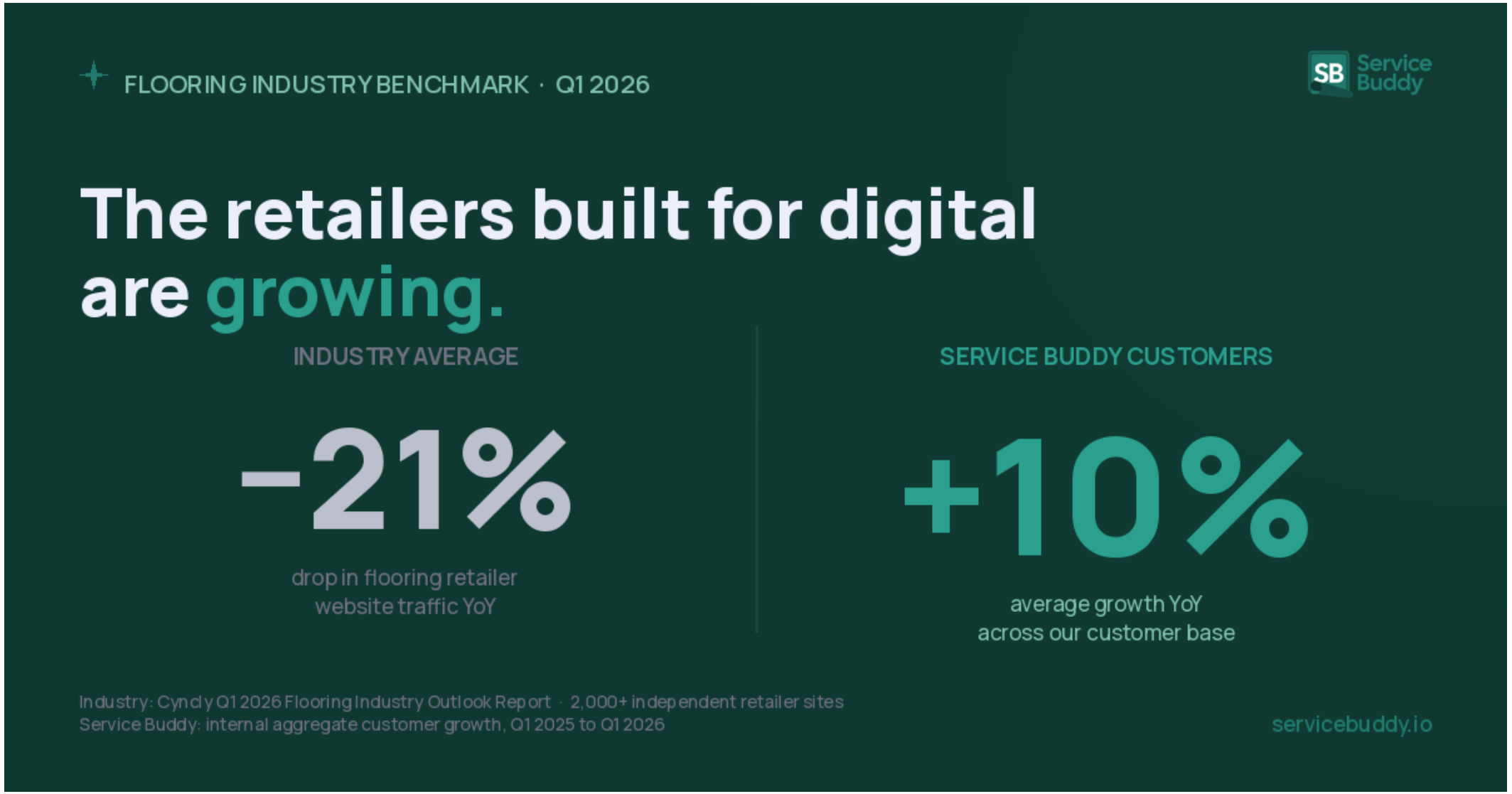
The web traffic numbers in flooring are ugly. The lead numbers tell a completely different story — and the retailers who understand the difference are about to take a lot of business from the ones who don't.
Cyncly's Q1 2026 Flooring Industry Outlook Report looked at more than 2,000 independent flooring retailer websites and found something most retailers haven't fully processed yet. Website visits are down 21% year over year. Phone call leads are down 22%. But form submissions? Down only 5%.
That gap — roughly four to one between phone leads collapsing and form fills holding firm — is the single most important data point for any flooring retailer planning the back half of 2026. It changes what a digital lead actually is, how fast you need to respond to it, and which retailers are going to capture the deferred renovation demand when it finally converts.
The Headline Most Retailers Are Missing
Top-line traffic down 21% is the kind of stat that makes retailers panic about their marketing budget. It shouldn't. The buyers haven't gone away. They've just changed how they shop.
Here's what's actually happening across the 2,000+ retailer sites in the Cyncly data set:
- Website visits: down 21% year over year
- Phone call leads: down 22% year over year
- Online form submissions: down only 5% year over year
Phone calls and total traffic are falling together at roughly the same rate. Form submissions are holding nearly flat. That divergence is not random. It is the entire flooring shopper journey reorganizing itself in real time.
The person who used to walk into your showroom on a Saturday is now spending three weekends online before they'll talk to you. They're reading blog posts about carpet fiber durability, comparing rug pad options, watching install videos, and pricing out their square footage on a calculator before they ever raise their hand. By the time they fill out your contact form, they are not browsing. They have already decided.
What a Form Fill Means in 2026
A few years ago, a form fill was a tire-kicker. Someone curious enough to type their email but not motivated enough to call. The phone lead was the prize. The form fill was the consolation.
In 2026 it is the opposite.
Phone lead volume is collapsing because the buyers who used to call early in their process are now researching online instead. The shoppers willing to pick up the phone now are either older buyers who never moved their habits online, or buyers so far down the funnel they've already done all the research and are ready to schedule the measure. Either way, phone volume is no longer a reliable measure of demand.
Form fills are now the highest-intent lead a flooring retailer gets. The person filling out your form has self-selected through three or four weekends of research, narrowed their options to a small set of stores, and is signaling they are ready to engage. They are not asking what carpet costs per square foot. They are asking which store they want to buy it from.
Treat that lead like a Saturday morning showroom visitor, because that's what it functionally is — except they're not standing in front of you, and they will absolutely fill out the next store's form if you don't respond fast enough.
Why Quote Speed Is Now the Whole Game
The shift from phone-led to form-led shopping creates a brutal new bottleneck: response time.
When buyers called, your sales process started in real time. You answered, qualified, scheduled the measure, and you owned the relationship within minutes. With form fills, the clock doesn't start until you reply. And every minute the lead sits in an inbox is a minute the buyer is reading the next store's About page.
Industry data tracking response times across home services consistently shows that retailers responding within an hour close at materially higher rates than those responding the next day. Inside flooring specifically, the gap between sub-30-minute responders and 24-hour responders is the difference between a healthy close rate and a leaky funnel.
Most flooring stores are losing this fight without realizing it. The form goes to an inbox. The inbox gets checked between customers. The reply goes out after lunch, or the next morning, or after the weekend. By then, the buyer has filled out forms at two other showrooms and is comparing whoever got back to them first.
The Operational Problem Behind the Lead Problem
The reason form response is so slow at most flooring retailers is not laziness. It's operational architecture.
The typical independent flooring store runs on five or six disconnected tools: a website with a contact form, an email inbox, QuickBooks, a measurement app, a spreadsheet for jobs in progress, and a CRM that nobody actually keeps current. A new lead has to be manually entered into the CRM, manually assigned to a salesperson, manually followed up on, and manually quoted. Each handoff adds hours. Each tool switch adds friction.
This was fine when phone calls were the dominant lead channel — a phone call forces real-time engagement and bypasses the entire downstream tool chain. But form fills have no such forcing function. They flow into a system that was never built to handle them at speed.
The retailers who are quietly winning right now are the ones who have collapsed this stack. Lead lands, sales rep gets a notification on their phone, quote goes out the same hour, and the customer signs digitally before they've had time to fill out another form.
Carpet Is Quietly Becoming the Bigger Opportunity
There's a second finding in the Cyncly data worth pairing with the lead-volume story. Of all the product categories tracked, carpet was the only major gainer in Q1 2026 product views — up 3.1 percentage points to 26.1% share. LVT and waterproof, still the category leader, lost 3.5 points of share. Laminate slid further. Hardwood and tile were flat.
Carpet is making a quiet comeback in consumer interest after years of being treated as the category that LVT was eating. For retailers who never abandoned their carpet expertise — and for rug-focused showrooms — this is the most favorable consumer-demand environment they've seen in years.
The retailers positioned to capture it are the ones who can move fast on the new lead profile: highly researched, form-driven, ready to buy. That's a sales motion built around speed and expertise, not foot traffic and follow-up calls.
Four Things Flooring Retailers Should Do This Quarter
1. Move your form response target to under 30 minutes during business hours
Not an hour. Not same-day. Thirty minutes. The retailers who own this metric will quietly take share from the ones who don't, and it won't show up in any industry report until it's already happened.
2. Treat form fills like the highest-priority lead they now are
Stop routing them to a general inbox. Route them directly to the salesperson on the floor, with a notification that can't be ignored. The lead that took the buyer three weekends to send deserves a response that takes you three minutes.
3. Cut the number of tools between lead and quote
Every additional handoff costs you minutes you don't have. The retailers winning on speed have one platform handling lead intake, quoting, scheduling, and follow-up, not five.
4. Lean into educational content
The Cyncly data shows blog posts and educational pages now compete head-to-head with product catalog pages for traffic. Content is no longer the marketing team's side project — it's the top of your funnel. Buyers are researching for weeks before they fill out a form. Make sure your site is one of the places they're researching.
What This Looks Like With Modern Flooring Software
Service Buddy is the AI-native operating platform built specifically for flooring, carpet, and rug retailers. It runs the full workflow — quotes, proposals, invoicing, payment processing, inventory, scheduling, and CRM — in one place, so the moment a form fill lands, the salesperson has the customer on their phone, the quote drafted, and the response on its way before another store has even opened the email.
That's the operational difference between a 30-minute response and a 24-hour one. And in a market where 95% of remaining digital leads come through forms, it's the difference between growing your share of a softer market and watching it walk to the store that responded faster.
FAQ
Why are flooring website visits down so much in 2026?
Existing home sales are still below historical norms, housing turnover is soft, and many homeowners have deferred renovation decisions. According to Cyncly's Q1 2026 Outlook, traffic to over 2,000 independent flooring retailer websites was down 21% year over year. The buyers haven't disappeared — they're shopping less frequently but with higher intent when they do.
Why did form submissions only drop 5% when traffic dropped 21%?
Because the buyers who do come to flooring retailer websites in 2026 are further along in their research than ever before. They're filtering themselves more aggressively before reaching out, which means a higher percentage of total visitors are converting into form fills. Form submissions now represent some of the highest-intent leads a flooring retailer can get.
How fast should a flooring store respond to a web form lead?
Under 30 minutes during business hours is the new benchmark for top-performing flooring retailers. Beyond an hour, close rates drop sharply. By the next business day, most buyers have already engaged with a competitor who responded faster.
Is carpet still a good category for independent flooring retailers in 2026?
Yes. Cyncly's data shows carpet was the only major flooring category to gain product-view share in Q1 2026, climbing 3.1 percentage points to 26.1%. LVT and waterproof still lead overall, but carpet is gaining ground on it for the first time in years. For carpet- and rug-focused retailers, the consumer-demand environment is improving.
What's the best flooring software for handling web form leads quickly?
The best flooring software for fast lead response is a single platform that combines CRM, quoting, scheduling, and payment processing — so a lead can move from form submission to signed quote without leaving one system. Service Buddy is built specifically for flooring, carpet, and rug retailers and is designed around the speed problem the Cyncly data exposes.
Key Takeaways
- Website visits are down 21% but form fills are down only 5%. The gap means form submissions now represent the highest-intent leads in flooring.
- Phone leads are collapsing too — down 22%. Buyers who used to call early in their process are now researching online for weeks first.
- Sub-30-minute form response is the new standard. Beyond an hour, you're losing the lead to whichever competitor replied faster.
- Carpet is gaining share for the first time in years. Up 3.1 points in Q1 2026 product views — the only major category to gain ground.
- The operational fix is collapsing your tool stack. Lead intake, quoting, scheduling, and payment in one platform — not five — is what makes a 30-minute response physically possible.
Service Buddy is the AI-native operating platform built for flooring, carpet, and rug retailers — quotes, payments, inventory, scheduling, and CRM in one place. Get your free demo here.
Related Blog Posts

.svg)

See Service Buddy in action with a live demo
Everything you need to run your flooring business, Service Buddy is your all-in-one management platform.