
What Is Your Flooring Store Worth? A Valuation Guide
How flooring stores are valued, what buyers and the next generation look for, and five changes that raise the number whether or not you ever sell the business.

What Is Your Flooring Store Actually Worth? A Valuation Guide for Owners Who Might Sell Someday
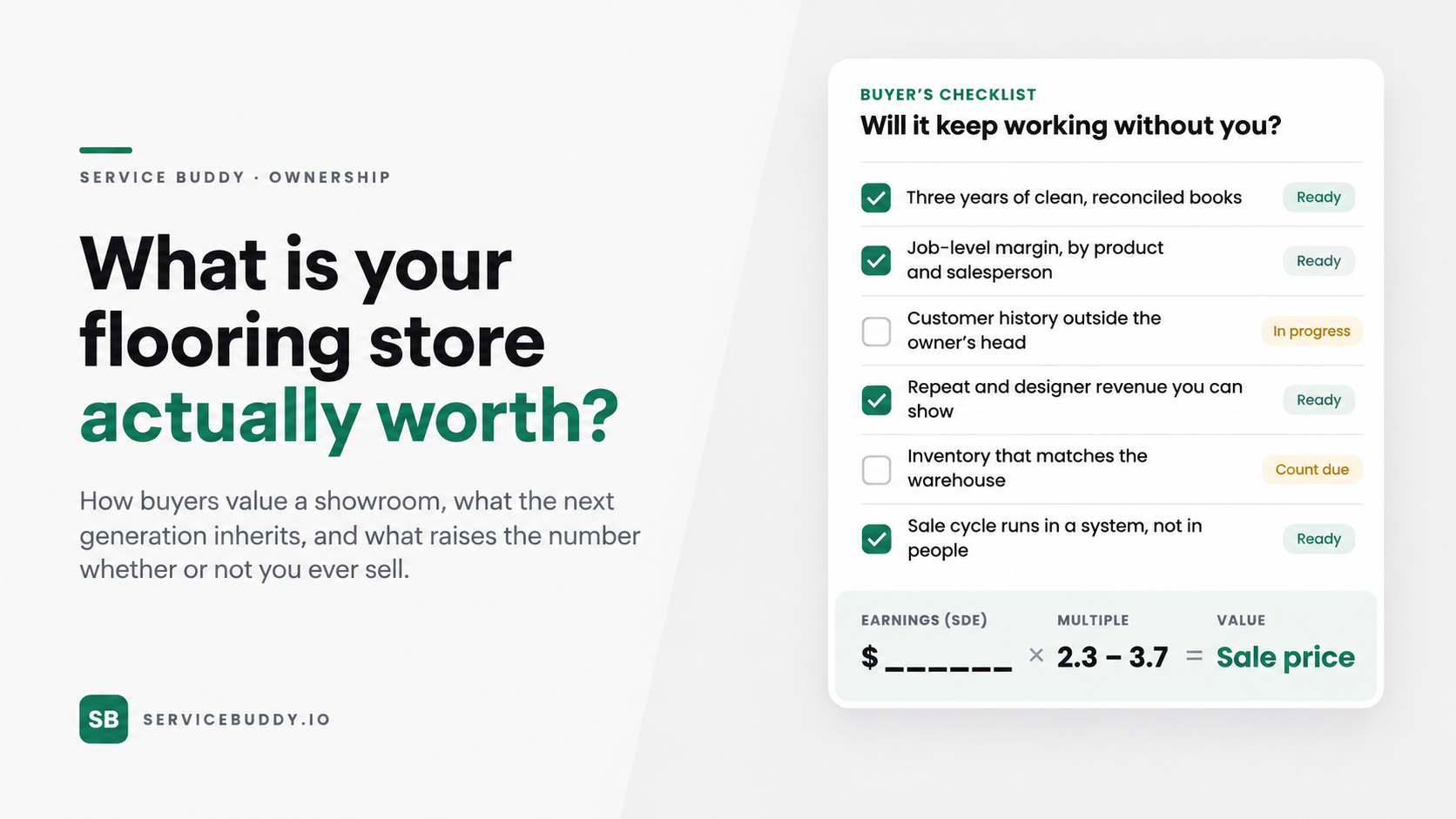
An independent flooring store is usually valued as a multiple of its seller's discretionary earnings (the profit plus the owner's salary and perks), adjusted for how much of the business depends on the owner, how clean the records are, and how repeatable the revenue is. Inventory, vehicles, and equipment set a floor. Everything above that floor is goodwill, and goodwill is what a buyer pays for when they believe the store will keep producing without you. Most flooring owners have never calculated this number, and most of what lowers it can be fixed years before a sale.
This isn't a post about selling. Most of you aren't planning to, at least not this year. It's a post about what your store would be worth to someone else, because that number is also a fairly honest report card on how the business runs today. The things that make a showroom worth more to a buyer are the same things that make it easier to own.
One note before we start: I'm not a broker, an accountant, or a lawyer. What follows is how small businesses are generally valued and what I've seen in the showrooms I've worked with. When you get serious about a transition, hire people who do this for a living.
Why this matters now
The flooring retail business is, in large part, a family business run by people who have been doing it for a long time. That's true across Main Street generally. The Exit Planning Institute reports that 51% of the current American business market is owned by Baby Boomers, who are set to transition over the next zero to ten years. The same page carries a harder number: only 20 to 30% of businesses that go to market actually sell.
Read those two together. A lot of flooring stores are going to change hands in the next decade, through a sale, a transfer to the next generation, or a quiet closing. Most of the ones that try to sell won't. The difference between the ones that do and the ones that don't is rarely the location or the product line. It's whether a buyer can see the business clearly and believe it will keep working after the owner walks out.
How a small business gets valued
There are a few methods, but for an independent flooring retailer the conversation almost always comes down to one: a multiple of earnings.
Seller's discretionary earnings (SDE) is net profit with the owner's compensation, benefits, one-time expenses, and personal items run through the business added back. It's the number that answers "how much does this store actually produce for the person who owns it?" Buyers of small businesses work from SDE. Larger buyers work from EBITDA, which is similar but doesn't add back the owner's salary.
The multiple is what the market will pay per dollar of those earnings. BizBuySell's Insight Report for the third quarter of 2026 puts the median sale price for a small business sold through its marketplace at $350,000, on median cash flow of $156,000 and median revenue of about $670,000. The same report shows the gap between small and larger deals: businesses that sold for more than $1 million averaged 3.73 times cash flow and 0.97 times revenue, while those under $1 million averaged 2.30 times cash flow and 0.62 times revenue.
Those are economy-wide figures, not flooring-specific, and they reflect businesses that actually closed. Your store might land above or below them. But they tell you the shape of the thing: a typical Main Street business sells for roughly two to four times what it earns for its owner, and the multiple rises as the business gets bigger, cleaner, and less dependent on one person.
The asset floor sits underneath. Inventory at cost (realistically, not what the spreadsheet says), vehicles, cutting equipment, showroom fixtures, and any real estate if you own it. For a store with weak earnings or weak records, the asset value may be most of what a buyer will pay. For a store with strong, documented earnings, assets are a small part of the price and goodwill is the rest.
Which brings us to the real question.
What a buyer (or your kid) actually looks for
Whether the next owner is a competitor, a private buyer, a manager you're selling to, or your daughter, they are all trying to answer the same question: will this keep working without you? Here is what they look at to decide.
1. Records they can trust
Three years of clean profit-and-loss statements, reconciled to tax returns, with job-level margin visible. Not "we did about two million last year." A buyer will want to know margin by product category, by salesperson, and by job type, and whether the installs are profitable on their own or subsidized by the material.
Most flooring stores can produce the first part. Very few can produce job-level margin without a week of work, because the quote lives in one place, the purchase order in another, and the install cost in a third. If a buyer has to rebuild your margins from receipts, they'll discount the price to cover the risk that they're wrong.
2. Revenue that isn't you
If the three biggest designers in town buy from your store because they buy from you, a buyer sees a relationship that leaves with you. If those designers have trade accounts with pricing, order history, and a salesperson they already work with, a buyer sees an asset.
The same goes for repeat customers. A store where 30% of revenue comes from people who have bought before is worth more than a store where every sale is a stranger from a Google search. A buyer can't see that number unless you can show it.
3. Customer history that exists outside your head
You know that Mrs. Alvarez bought the wool runner in 2019, had a stair issue in 2021, and asked about a dining room rug last spring. Does anyone else? Is it written down anywhere a new owner could find it?
The customer list is often the most valuable thing a flooring store owns, and the least documented. A list of names with no history is a mailing list. A list with quotes, jobs, products, and conversations attached is a business.
4. A documented way of working
What happens between the quote and the install? Who takes the deposit, when, and how much? What triggers the purchase order? When does the install get scheduled, and what has to be true first? If the answer is "it depends, ask Linda," a buyer is buying Linda, and Linda may not be staying.
This doesn't require a binder of procedures. It requires that the process live in a system rather than in people, so that a new owner can watch a job move through it and understand how the store runs.
5. Inventory you can count
A buyer will want to walk the warehouse with your inventory list. If the list says 40 yards and the roll has 28, or there are twenty remnants on the floor and six on the sheet, every number you've given them becomes suspect. Inventory accuracy isn't about the inventory. It's about whether the rest of your records can be believed.
6. The installer bench
Who does your installs, how long have they worked with you, and would they keep working with a new owner? Installers are frequently the real constraint on a flooring store's capacity, and a buyer knows it. A stable crew with a track record is worth money. A revolving door is a risk they'll price in.
7. Lease, location, and the boring stuff
How long is left on the lease, and is it assignable? Are vendor relationships in the business's name or yours? Are there any disputes, liens, or chargebacks hanging around? None of this changes what the store earns. All of it changes whether a deal closes.
The owner-dependence discount
Of all of these, the one that destroys the most value is the one owners are proudest of: being the person who holds it all together.
You know every customer. You price every quote. You call the mill when something's late. You remember which roll is on hold for whom. It's why the store works. It's also why it's worth less than it should be, because a buyer looks at that and sees a business that stops working the day you leave.
I've written about this from the operations side in why your carpet and rug store breaks when one employee is out. The valuation side is the same argument with a price tag. Every process that lives in your memory instead of in a system is a discount on the sale price. Every one you move out of your head is a raise.
Five things that raise the value whether or not you ever sell
You don't have to be planning an exit to do these. They are also just good ways to run a store.
1. Get job-level margin out of your books, automatically. If you can't see what each job made without a spreadsheet, start there. The goal is that every quote, purchase order, and payment posts to the same record and reconciles to QuickBooks without someone re-keying it.
2. Move customer history into a system. Every quote, job, product, and conversation attached to the customer, visible to whoever's at the desk. This is the single biggest transfer of value from your head to the business.
3. Build the repeat and trade revenue line. Set up real trade accounts for designers with pricing and order history. Track repeat purchases. In a year, you'll be able to show a buyer what share of revenue comes back on its own.
4. Run the sale cycle in a system, not in people. Quote, approval, deposit, order, install, balance. If a new hire can watch a job go through it and understand the store in a week, so can a buyer.
5. Count the inventory, then keep it counted. One real count, then a system that deducts when you sell and updates when you receive. The warehouse walk with a buyer should be boring.
Succession is a valuation too
Not every transition is a sale. Plenty of flooring stores pass to a son, daughter, or long-time manager. The price might be a handshake. The valuation question is still there: is the next person inheriting a business or a job?
Some of the stores we work with have been doing this for generations. Mal Elfman's Flooring has served Greater Boston since 1915 and is now in its fourth generation. When they moved their operations into Service Buddy, the stated reason was day-to-day: a team member described it as feeling like they were doing more paperwork than flooring. But the effect of getting quotes, payments, work orders, and schedules into one place is also that the next generation inherits a store they can see, not a store they have to decode.
Dover Rug & Home replaced a point-of-sale system they'd used for more than 20 years. That's two decades of customer and transaction history that now lives somewhere a new owner, a new manager, or a new salesperson can actually use.
Where software fits
Software doesn't make a flooring store valuable. Earnings do. What software does is make the earnings visible and transferable, which is most of the difference between a store that sells at a good multiple and one that doesn't sell at all.
In Service Buddy, every quote, job, payment, and refund updates the financials automatically and posts to QuickBooks Online, so job-level margin and commissions are a report, not a project. The customer record holds the quotes, jobs, payments, and messages for every customer and designer, and inventory is tracked by roll, rug, and remnant with QR-code labels, deducted when sold and updated when received. Those three things, clean books, documented customers, and countable inventory, are the first three items on any buyer's list.
If you're years from a transition, that's the right time to start. The records a buyer will ask for in 2031 are the records you're creating, or not creating, this week.
Frequently asked questions
How is a flooring store valued?
Most independent flooring retailers are valued as a multiple of seller's discretionary earnings (net profit plus the owner's salary, benefits, and one-time or personal expenses added back), with inventory, equipment, and vehicles setting a floor. The multiple depends on size, record quality, how much the business relies on the owner, and how repeatable the revenue is. A broker or valuation professional can give you a number specific to your store.
What multiple do small businesses sell for?
BizBuySell's Q3 2026 Insight Report shows businesses sold for under $1 million averaged 2.30 times cash flow and 0.62 times revenue, while those sold for more than $1 million averaged 3.73 times cash flow and 0.97 times revenue. The overall median sale price was $350,000 on median cash flow of $156,000. These figures cover all industries, not flooring specifically.
What lowers the value of a flooring store?
The biggest discount comes from owner dependence: customer relationships, pricing, vendor contacts, and process knowledge that live only in the owner's head. Other common drags are records that can't be reconciled, job margins that can't be shown, inaccurate inventory counts, an unstable installer crew, and a short or non-assignable lease.
How far ahead should I prepare to sell a flooring business?
Buyers typically want to see at least three years of clean, reconciled financials, so the practical answer is three to five years before you intend to transition. Many of the changes that raise value, like moving customer history into a system and tracking job-level margin, also make the store easier to run in the meantime.
Does inventory count toward the sale price?
Usually inventory is valued separately at cost and added to the price, or negotiated as part of it, which is why an accurate count matters. Discrepancies between the inventory list and what's physically on the floor make buyers question every other number you've given them.
See what a buyer would see
If you want to know how your store would look to someone trying to understand it from the outside, the fastest way is to pull up job-level margin, customer history, and a live inventory count, and see how long it takes. If the answer is "a few days," book a live demo and we'll show you what it looks like when it's a few seconds.
This article is general information about how small businesses are commonly valued. It is not financial, legal, or tax advice. Consult a qualified business broker, CPA, or attorney before making decisions about selling or transferring your business.
Related Blog Posts


See Service Buddy in action with a live demo
Everything you need to run your flooring business, Service Buddy is your all-in-one management platform.