
Flooring Software Onboarding: What Happens After You Sign
Most flooring software is sold on the demo and judged on the onboarding. What migration, training and support should look like after you sign.

Flooring Software Onboarding: Why the Days After You Sign Matter More Than the Demo
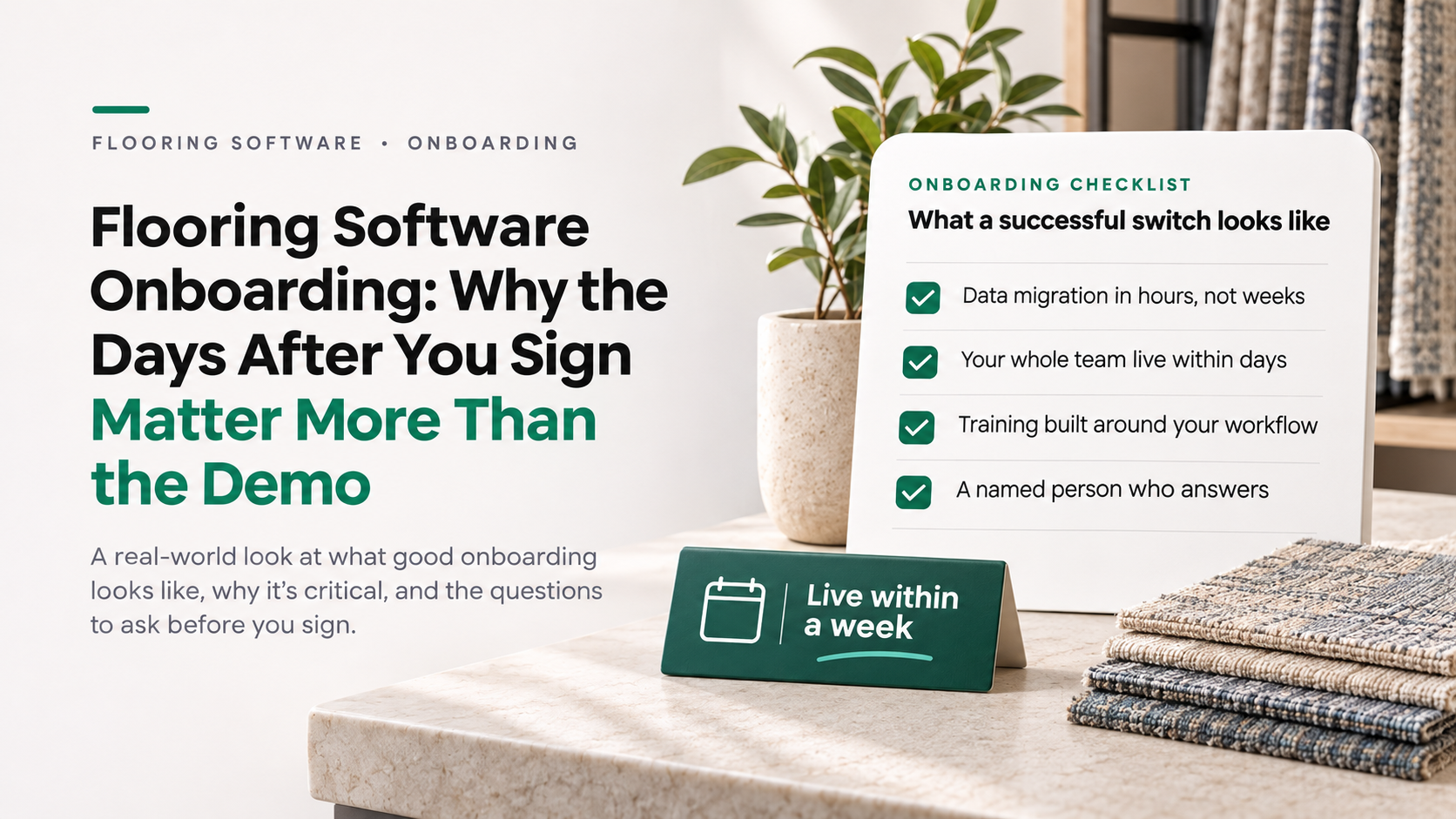
Flooring software onboarding is the stretch between signing a contract and your team actually running the store in the new system. Done well, data migration takes hours, your whole team is live within days, and when something's off you reach the people who built the software. Done poorly, it drags on for months while you pay for two systems and your salespeople quietly go back to the whiteboard.
Most flooring software is sold on the demo and judged on the onboarding. This post uses a real switch, Red Baron Carpet in Newtown, Connecticut, to show what good looks like, where legacy flooring software falls short, and the questions to ask any vendor before you sign.
A review that says it better than we can
A few days ago, one of our newest customers left Service Buddy a Google review. Red Baron Carpet is a flooring showroom in Newtown, CT. Nick and his team had been paying Cyncly every month for a website with a free CRM duct-taped to it. We migrated their data to Service Buddy in about an hour. Within days, their entire team was live, onboarded, and trained.
Here's part of what they wrote:
"Our entire onboarding, setup, and training took DAYS. Meanwhile, legacy flooring software companies were quoting MONTHS just to get their outdated systems operational."
"Tom, the founder, CEO, and the man who actually designed the software, is usually the guy personally answering your questions and providing support... No getting bounced around corporate support departments, no scripted Tier 1 representatives who barely understand the product, and no explaining your problem five different times."
We're proud of that review. But the reason it's worth a blog post is what it says about the industry, not about us. A flooring retailer was so used to months-long implementations and faceless support queues that days and a direct line felt remarkable. That's the bar legacy flooring software has set. It shouldn't be.
Why signing the contract isn't the finish line
When a flooring store picks the software that runs their business, they're handing over a tremendous amount of trust. Every quote, every deposit, every install date, every customer record lives in that system. If it goes sideways, the store doesn't just lose a tool. It loses days of selling and the confidence of the team.
The vendor's incentive, though, often ends at the signature. Sales teams are paid on closed contracts. Implementation gets handed to a different department. Support gets handed to a third. By the time you have a real question, nobody you talked to during the sales process is in the room.
You don't earn customers for life by getting them to sign. You earn that trust every single day after they sign. Any vendor can say that. The onboarding is where you find out whether they mean it.
What flooring software onboarding should actually look like
Here's what a modern switch should look like for an independent flooring or rug retailer. If a vendor can't commit to something close to this, ask why.
Data migration measured in hours
Your customer list, open quotes, product catalog, and vendor records are the core of the migration. For most carpet and rug showrooms, that's a few spreadsheets or an export from the old system. Cleaning and importing that data should take hours, not weeks. Red Baron Carpet's migration took about an hour. A multi-location store with years of history may take a day or two. If a vendor quotes weeks for migration alone, they're either working off a rigid legacy architecture or planning to bill you for the time.
Your whole team live within days
"Live" means your salespeople are writing quotes in the new system, your office is invoicing from it, and your installers are looking at the schedule in it. That should happen within a week of signing. Our standard commitment is simple: live within a week, about five hours of your time. Service Buddy does the heavy lifting; the store's five hours go to training and sign-off, not data entry.
Training built around your workflow, not a generic curriculum
Flooring retail has a specific sales cycle: a lead comes in, you quote, maybe a rug goes out on approval, a deposit comes in, the install gets scheduled, the balance gets collected. Training should walk your team through that cycle with your products and your customers in the system, not a demo database full of placeholder data. Two or three focused sessions, scheduled around your showroom hours, beat a 40-page manual every time.
A named person who answers
The single biggest predictor of a successful switch is whether the store has one person they can text or call who knows both the software and their business. Not a ticket queue. Not a chatbot that escalates to a Tier 1 rep reading a script. A person.
The support test: who picks up when something breaks?
Here's a quick way to evaluate any flooring software vendor. Ask them: if my salesperson can't figure out how to apply a customer's deposit across two orders on a Saturday morning, who do they contact, and how long until they hear back?
Watch how they answer. "Submit a ticket through the portal" is a red flag. "Your dedicated CSM will respond within two business days" is a red flag dressed up nicely. The answer you want names a person and a channel, and the response time is measured in minutes or hours.
Why a small, focused team wins here
Large legacy vendors have a structural problem. The people who built the product are three layers removed from the people who support it. Every support interaction starts with you re-explaining your business. A smaller, focused team doesn't have that problem. At Service Buddy, the founder who designed the software still runs onboarding calls and still answers support questions personally. That's not a marketing line. Nick put it in a public review because it was his actual experience.
You'll hear this described as a weakness: "What happens when they grow?" Fair question. The honest answer is that the support model scales by hiring people who know flooring and giving them real access to the product team, not by inserting a ticket layer between you and the answers. The day a support call requires five hand-offs, we've failed.
What "duct-taped together" actually costs you
Red Baron Carpet's situation before switching is common. A flooring store pays a monthly fee for a website and gets a basic CRM bundled in. The two technically talk to each other. Nothing else does. Quotes live in a template. Payments run through a separate terminal. Scheduling is a shared calendar or a wall. Inventory is a spreadsheet.
The cost of that setup never shows up on a single invoice, which is why stores tolerate it for years. It shows up as:
- Quotes that take 20 minutes to build and go out hours after the customer leaves the showroom
- Deposits collected in one system and tracked in another, with nobody certain what's been applied
- A customer calling about a rug on approval and three people checking three places to find the answer
- Follow-up that happens when someone remembers, not when the system prompts
We've written about the real cost of flooring store software in more detail. The short version: the monthly fee is the smallest line item. The hours and the lost sales are the real bill.
Five questions to ask before you sign
Use these in your next vendor call. The answers tell you more than the demo does.
- How long is a typical onboarding for a store my size, from signature to my team using it daily? Get a number in days or weeks, and ask what the longest one last year was.
- Who migrates my data, and how long does it take? You want the vendor doing the work, not a template for you to fill out.
- Who will I contact for support, by name, and through what channel? If the answer is a portal or a queue, press for what happens when the portal isn't fast enough.
- Can I speak to a customer who switched in the last 90 days? Recent customers remember the onboarding. Three-year customers don't.
- What does my team have to do, in hours? A vendor who can't answer this hasn't thought about your side of the switch.
You can read how other independent retailers answered these questions in our customer stories, including Redi-Cut Carpets & Rugs and Parker Carpet.
How Service Buddy handles the switch
Service Buddy is built exclusively for flooring, carpet, and rug retailers. One connected workflow runs from lead to quote to deposit to install to invoice to final payment, all on one customer record. Because the system was designed around how a flooring store actually sells, onboarding is mostly a matter of loading your data and showing your team where things are.
Here's how a switch runs:
- Before you sign: we look at your current system and data together, so the migration plan is set before day one.
- Days 1–2: we migrate your customers, products, vendors, and open quotes. Most stores are done in hours.
- Days 2–5: two or three training sessions with your team, using your real data, scheduled around your showroom.
- End of week one: your team is quoting, scheduling, and collecting payments in Service Buddy. The old system gets turned off.
- After that: you have a direct line to the people who built it, and we ship a new release roughly every two weeks based on what customers like you ask for.
We've moved stores off RMPro, QFloors, FloorZap, Pacific Solutions, Lightspeed, Broadlume, Cyncly, and off nothing at all but spreadsheets. Each one has its own quirks, and our switching guides cover the specifics.
The bottom line
Red Baron Carpet's review is a snapshot of one store's switch. But it points at something every flooring retailer evaluating software should hold onto: the demo tells you what the software can do, and the onboarding tells you whether the company will show up for you. Judge the second one as hard as the first.
If you've been putting off a switch because you assume it means months of disruption, it doesn't have to. Days is a reasonable expectation. A named person who answers the phone is a reasonable expectation. Hold your next vendor to both.
Frequently asked questions
How long does flooring software onboarding take?
With a modern, flooring-specific platform, data migration takes hours to a couple of days and the full team is typically live within a week. Legacy flooring software vendors commonly quote several weeks to several months, largely because of rigid data structures and multi-department implementation processes.
What data gets migrated when you switch flooring software?
The core migration includes customers and contact history, products and pricing, vendors, and any open quotes or jobs. Historical invoices can also be imported if the old system can export them cleanly. For most carpet and rug retailers, this data lives in a few spreadsheets or a single export from the previous system.
How much of my team's time does switching flooring software take?
A well-run switch requires roughly five hours from the store, spread across one to two weeks, mostly for training sessions and sign-off on migrated data. The vendor should handle the data work.
Should I switch flooring software during busy season?
You can. Because migration takes hours and training is a few short sessions, the disruption is limited. Many stores prefer switching ahead of a busy stretch so the team is working in the new system before volume picks up. The worst option is staying on a system that costs your team hours every week because a good time never comes.
What should I look for in flooring software customer support?
Look for a named contact, a direct channel (phone or text, not only a ticket portal), response times measured in hours, and support staff who understand flooring retail. Ask who you'll actually talk to and whether they've worked in or around a flooring store.
Is Service Buddy a Cyncly alternative?
Yes. Service Buddy replaces the website-plus-CRM bundles and legacy point-of-sale systems many flooring retailers have been paying for, with one workflow that covers quotes, payments, scheduling, inventory, and CRM built specifically for flooring, carpet, and rug stores. Red Baron Carpet migrated from Cyncly to Service Buddy in about an hour.
See it for yourself
If you run a flooring showroom, rug store, or carpet retail business and you're tired of software that was sold well and supported poorly, let's talk. You'll meet the person who designed the software, see it running with flooring data, and get a straight answer on what your switch would take.
Book a demo with Service Buddy →
Read the original LinkedIn post from Tom Strachan, Founder & CEO of Service Buddy: linkedin.com. Learn more about Red Baron Carpet at redbaroncarpet.com.
Related Blog Posts


See Service Buddy in action with a live demo
Everything you need to run your flooring business, Service Buddy is your all-in-one management platform.